
Eurydice
A retelling of the myth of the Greek hero Orpheus, by Sarah Ruhl

Before we even start, it’s pronounced Yer-IH-dih-see.1
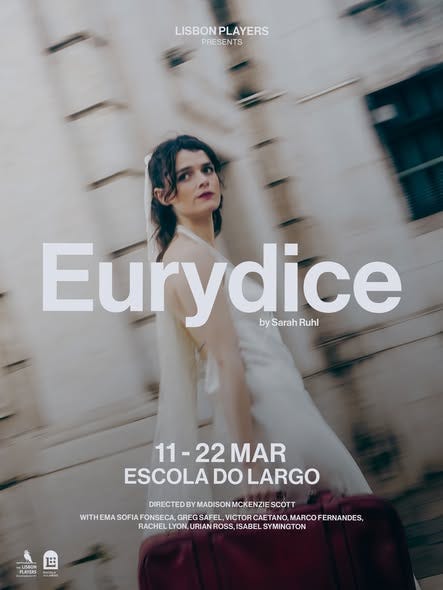
And it’s the next play I’m lucky enough to be stage managing. We open March 11 for a ten-show run that concludes on March 22.
For those who are new to our blog and for those with short memories, I’ve managed to connect with the Lisbon Players, a theater company that performs in English, and have been the stage manager for three plays dating back to last summer. Before moving here, I’d had basically no theater experience other than a grade-school play and being part of the pit orchestra for musicals at the high school I worked at in my previous life.
My post about Fallen Angels, the last play I was part of, talked a lot about how different it was from the previous two I’d worked on, The Unfriend and The Event.
Those differences were centered on my specific role. Because it’s all about me, right?
While Fallen Angels was different from the first two plays I’d done, this one is different-er still, and for entirely different reasons.
Fans of Greek mythology may know the name Eurydice. She is the wife of Orpheus, a Greek hero whose music had the power to charm not just all living creatures but also inanimate objects, like stones.
In one oft-told tale, Orpheus descends to the Underworld to recover his beloved, deceased wife. On his journey, his music charms Cerberus, the three-headed canine guardian of the gates of hell, and inspires Hades to allow Orpheus to return with Eurydice on the condition that he not look back at her until they leave the Underworld. If Orpheus so much as glances behind him, Eurydice will be compelled to stay behind. (Spoiler: He looks back. At the last possible moment. It’s quite tragic.)
Eurydice, written by American playwright Sarah Ruhl in 2003, tells that story from the perspective of Eurydice. We follow her experiences while Orpheus finds a way to reach her, and we see what happens when they meet again after he does.
To say much more would venture into spoiler territory but the play introduces a new character, Eurydice’s father, and - as all good Greek plays should - features a chorus. In this case, of stones. That talk. And move. For those who aren’t going to be able to come see it live, you can read a plot summary here.
So, yeah, this play is not at all like the others in so many ways.
The set
The first and perhaps most obvious way is the set. The other plays happened in recognizable locations. Two were in 20th-21st century homes, immediately identifiable to most anyone who would be likely to ever see the shows: living rooms, kitchens, tables, sofas, carpets. An audience member could walk into the theater, look at the stage and go, “ok. Got it.” The Event was a little less obvious at first glance but it was still approachable: a table topped by a rose in a vase. In all three cases, the set was merely a place where the action happened. It may have been a living room but it could almost as easily have been a bus station or a restaurant. The plays were about what the actors said and did, not where they said or did them.
In Eurydice, the set is basically the eighth2 character in the play. Much of the action takes place in the Underworld, which Ruhl in her stage directions says “should resemble the world of Alice in Wonderland more than it represents Hades.” The rest takes place in what we’ve been calling “above.” The play opens on a beach. There’s a scene in an “elegant high-rise apartment” that is “a giant loft space with no furniture.” And a couple of scenes by a water pump.
That’s a lot of heavy lifting for a set. And yet there’s actually not much to ours. At least not physically. On our stage, there will be a basin of water, lots of cinderblocks that will be disguised as rocks, sand, and some blue fabric that represents a river. While one key aspect of the set is built on-stage during the show, the vast majority of the atmosphere will be conveyed through lighting and sound.
This is so for a few reasons. In no particular order:
It’s the Underworld. There’s no accepted map for that. Especially when you toss in the Alice in Wonderland bit.
Our stage is tiny. We’ll be performing in Escola do Largo, the same black-box theater where we mounted The Event, which was a monologue. It was a great stage for a one-man show. There are seven people in this cast.
Our budget isn’t much bigger than the stage. I wrote a little bit about the workings of the Lisbon Players a while ago. I still don’t know the ins and outs of the organization as well as I’d like but I’ve seen the budget for this play. The theater has 50 seats. There will be ten performances. Even if we sell every single one of the 500 available tickets (which, sadly, is unlikely), there’s no way Eurydice can break even.
We didn’t have a set designer until halfway through the rehearsal window. The timeline for this show is incredibly short. Madison McKenzie Scott, our rock-star director, was given the go-ahead by the Lisbon Players to mount the show right before the end-of-year holidays. She and I met on December 27th to talk about how this was going to work. At that point, there wasn’t even a place to hold auditions but we knew we had the theater for a mid-March opening. There are a few spots in any calendar year when getting something done in Portugal is incredibly difficult. The month of August is one of those. The last ten days of December/first week of January is another. Somehow, a location was secured and auditions were held on Jan 8 & 9. So the entire play will move from “three people and a script”3 to “on with the show, this is it” in two months. The set designer came on board in early February, the lighting designer several days later. I might not meet either of them until a few days before we open. If I meet them at all.4
The atmosphere
I mentioned above that a considerable amount of the look and feel of the show will be dictated by light and sound. One of the things I love the most about this production is the way some of the pieces have fallen together.
Auditions for Eurydice were a fascinating affair. My understanding is that in a “typical” casting call, an actor shows up, waits around in a crowd of other hopefuls, eventually gets called into a room where a few people from the production are sitting at a table, reads or speaks a few lines from a prepared piece, occasionally gets asked to try it a different way, and leaves after maybe five minutes of face time with the decision-makers.
The Eurydice auditions on January 8 & 9 were a bit more involved. There were more than 125 responses to the casting call. Rather than trot each person in for 5 minutes, Madison put them together in groups of +/-8 people and had each group come in for an hour.
That hour was divided into two parts. First, the groups split into teams of ~4 people, each of which collaboratively devised and performed a 2-3 minute piece of theater based on a specific, play-related prompt.56 Then, in front of the rest of the group, each actor performed the monologue associated with the part they most wanted to audition for.
In one of those groups, an actor brought a guitar (a few Orpheus hopefuls brought instruments with them). There happened also to be in that group a trained opera singer. Together, they improvised some music to accompany their team’s prompt interpretation.
It was spellbinding.
Madison, knowing a good thing when she heard it, hired them to compose original music for this play. Pierre Roxon and Marta Tavares each sing, play multiple instruments, and have composition experience. They met at the audition but their collaboration feels seamless, like they’ve been working together for years.
Honestly, the music alone is reason enough to come see this play. You may be fortunate enough to experience Eurydice at another place or another time, but it is only here - for our ten-show run - that this music will be performed.
The lighting will also be a key element in establishing the scene. Oddly, the script contains only two lighting cues. It’s as if Ruhl is acknowledging the challenges inherent in staging this play and deliberately leaving a blank slate for each production. (Or maybe she knows nothing about lighting. 🤷♂️)
Ruhl does say in the staging notes that “the set should allow for fluid transitions from moment to moment - from underworld to overworld and back again.” Lighting will be a significant indicator of those transitions. In our production, there are roughly 2,689 lighting cues. Give or take.7 I’m glad I’m not operating the light board.
I will, however, be responsible for the sound during the show and that makes me nervous. I’ve hammered out some technical issues with the cueing software I’m using during rehearsals and Pierre recently suggested there might be better programs out there so I’m waiting for his recommendations. Nothing like learning a new software package less than two weeks before using it in front of a paying audience.
The themes
The other plays I’ve done were lighter affairs. The Unfriend and Fallen Angels were straight-up comedies, and while The Event had more of a philosophical tone and even a hint of melancholy at points, it wasn’t a freakin’ Greek tragedy.
While Eurydice has some laugh-out-loud moments (Marco Fernandes is brilliant in a role that is demanding both physically and emotionally), the play revolves around themes like grief and suicide. There are some uncomfortable-to-watch interactions between a male character and Eurydice. And, true to form, many people die. Some more than once. And all, tragically.
We’ve had conversations about how all of the “lump-in-throat” moments in Acts I and II have to be toned down a bit so the emotional peak of the play doesn’t get overshadowed. Also so the audience isn’t going through a wringer for 90 straight minutes.8
It’s actually been tough for me some days just to make it through rehearsals without bursting into tears. I’m slightly concerned about my ability to manage the sound board during shows and am hopeful that being at the far end of the room instead of three feet from the actors will help.
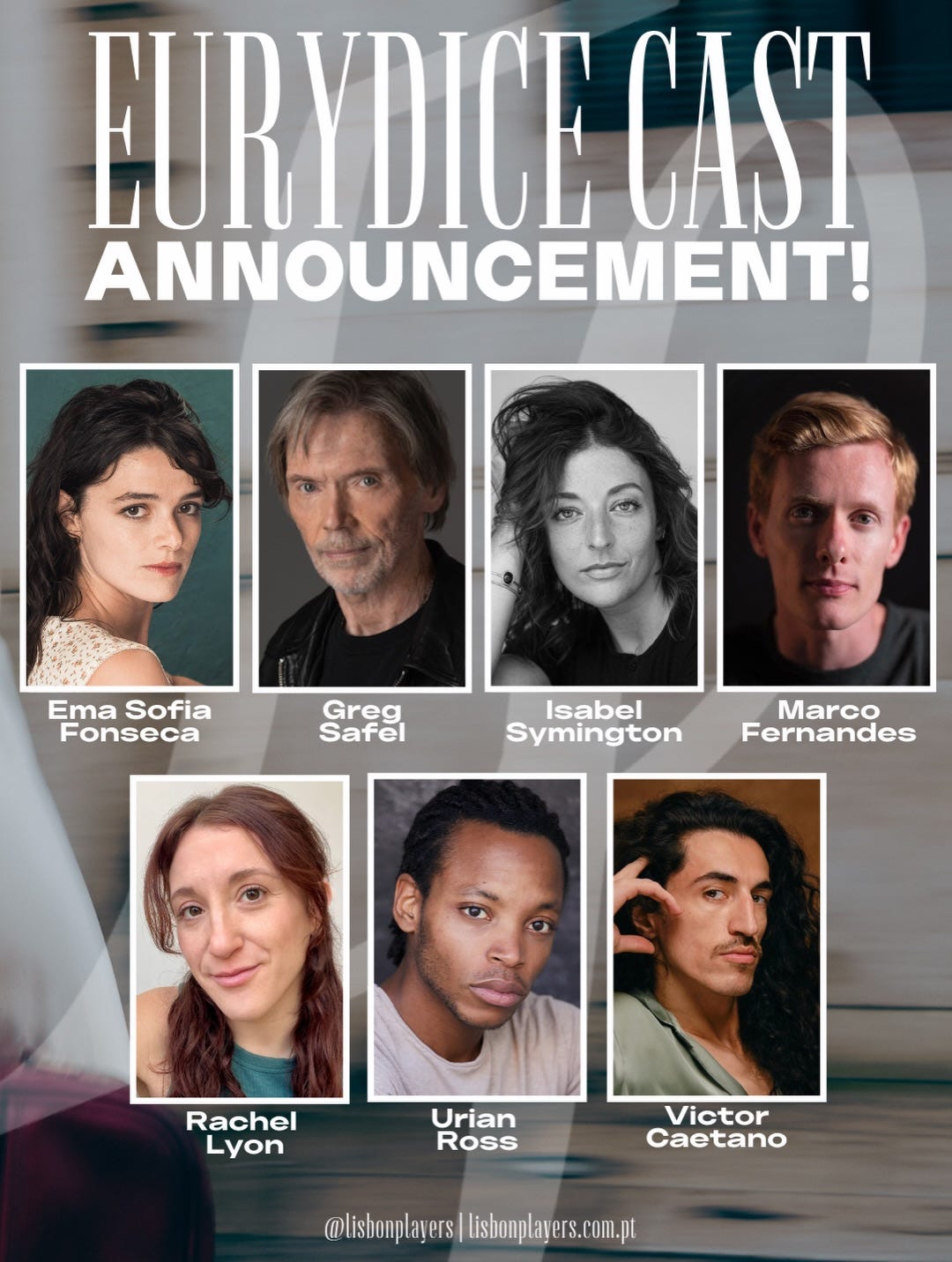
Those of you who saw Fallen Angels will recognize Ema and Marco. (Madison, our director, played Saunders in that show as well.) These guys all do an incredible job. It’s been an honor and a privilege to work with them.
I could probably rattle on for another 2,000 words about this show but I’ve already cost us enough subscribers. Thanks for making it this far. Hope to see you at Escola do Largo! (Link for tickets is here.)
That’s all for now.
Love from Lisbon,
Scott
Weather report
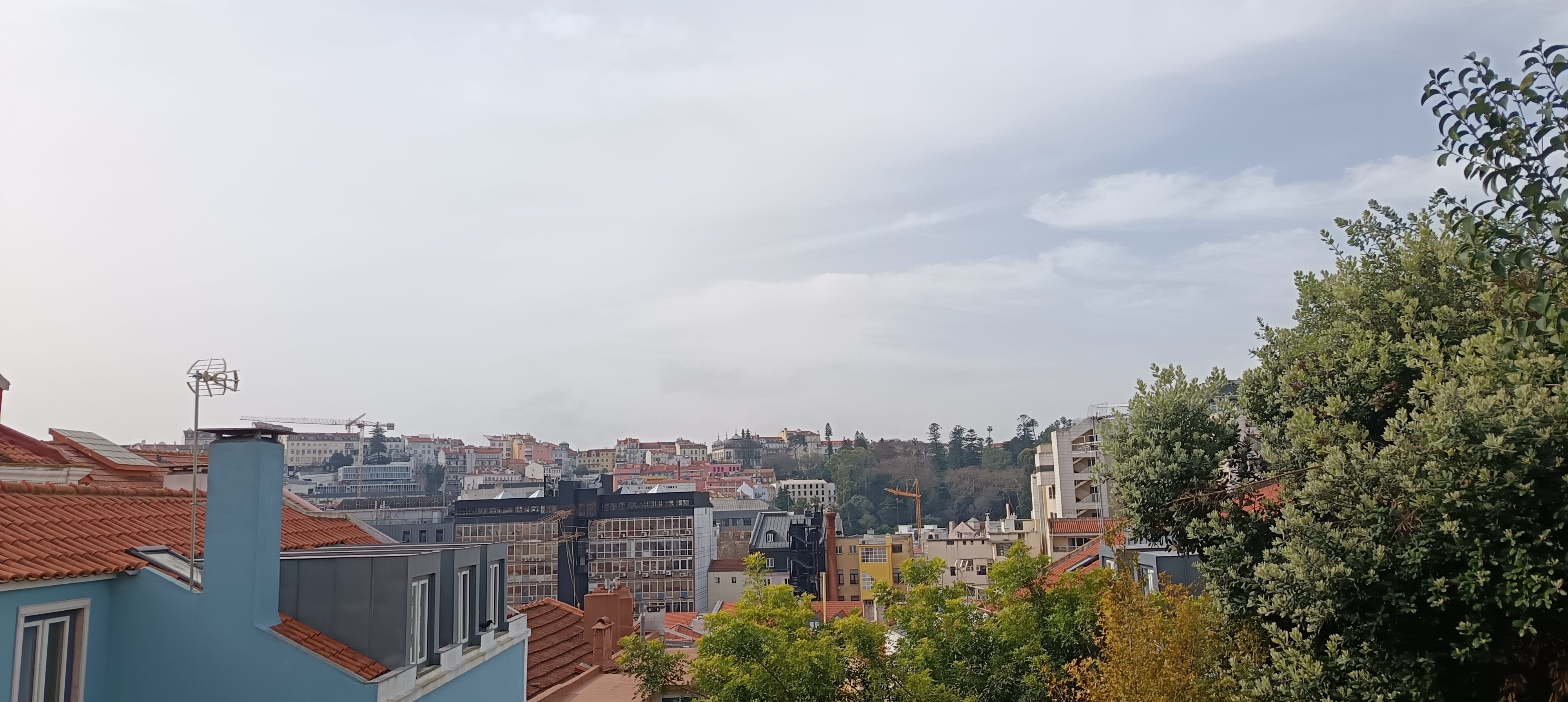
After weeks of unrelenting wind and rain that brought death and nearly a trillion euros worth of destruction to the country, things have finally begun to dry out. Temps will reach 18/65 degrees today. Which still feels warm for February.

Don’t worry, everyone gets it wrong. The auditions were two days of “how many creative ways can we find to pronounce this word?” and even one of the actors was still having trouble with it several days into rehearsals.
Have you ever just looked at a word and felt like “there’s no way this can be a word. It can’t possibly be spelled like that”? That’s “eighth” for me right now. g-h-t-h? Really?
The fact that I was one of those “three people” is still a thrill I can’t really get over.
I mean … it’s not strictly necessary that I meet them. It just feels weird given their importance to this production.
Example prompt: show us what happens when someone starts in the land of the living, passes through the river of forgetfulness, and comes out the other side into the Underworld.
The intention of this exercise was not the result but the process. Madison needed a cast that would be willing and able to work collaboratively to establish, create, and execute the vision for this play. This has not been a “top down” process. Everyone in the room has contributed ideas and suggestions for not just their own characters but for the show as a whole. Madison spent a some time during the auditions eavesdropping on the different teams so she could get a sense of who would thrive in the rehearsal environment she was looking to foster.
Fine, fine. The actual number is closer to 70. But still. It’s more than two.
Seriously, if you ever get to see this play, bring tissues.
Sooooo not to be a buzzkill but generative AI is a minefield of different... bads. It takes a ton of energy in proportion to what's being asked of it, it wastes fresh water, they were all trained entirely unethically on bodies of art that the artists got no compensation and gave no permission for, and it contributes to artists not getting further work, too, and the devaluation of artists in general. Not everyone knows this! But I am sharing in case you/anyone else was unaware. (:
Hi, Scott! Thanks for your thoughtful and detailed description of the making of your new production, Eurydice. As a former theater geek, I was so inspired by your story that i bought tickets for Saturday, March 14! This will be the first live theatre production that my husband and I have attended since moving to Portugal 2+ years ago. Thank you for bringing us back into the theatre!! We can't wait!