
Learning Portuguese
An account of my experience learning online with EdPro

My biggest challenge being in Portugal is learning Portuguese. Before we moved here, Scott and I immersed ourselves in Memrise - which has European Portuguese - but it did not begin to prepare us for boots on the ground speaking and listening. We could say a few words and have them be understood - olá, bom dia - but most everything else was not understood when we used it. When going in to a shop, we would first prepare a question, listen to Deepl’s audio of the question, practice it till it sounded the same, and then go in. Where we would be met with a completely blank expression.
From the moment he stepped off the plane, Scott threw himself into using Portuguese whenever and whereever he could. He did a great job of conquering the fear of looking foolish.
You simply will not learn the language if you don’t embrace
looking like a world-class idiot.
Yes, for the most part, it is possible to get around Lisbon without knowing much Portuguese. It’s not polite, sure. And there will be hiccups. At most places you’ll find someone somewhere who speaks English. Yes, it will be embarrassing, searching for an English speaking staff member will take more time, and you won’t feel a part of a community.
Knowing a little of Portuguese is only courteous. But, it gets you into trouble.
Amy, in the supermarket: Onde está a farinha de milho? (Where is the cornmeal?)
Clerk: words words words
Different learning methods
At 3 1/2 years in, Scott and I have used a wide range of options to learn Portuguese. Our first attempts were self-study and a tutor. Next, we tried a different type of self-study (much more effective) and a class led by a volunteer. Then Scott got into the free, government class that does not require you to take the CIPLE A1/A2 exam to get the almighty A1/A2 certificate.1 Finally, Scott braved the government B1/B2 class!
I’m definitely not doing as well as he is. I’m laying the blame for that squarely on some hearing loss, so getting used to new sounds is hard. It turns out I read lips a lot. Lip reading, for me, does not translate into a different language. Or at least not Portuguese, which has different sounds and is spoken faster and with considerably less enunciation. If you have hearing loss, be prepared that learning a language is a bit more challenging.
Menopause brain couldn’t possibly have anything to do with why
I’m so slow at learning Portuguese.
Unfortunately, because of some medical conditions, taking the government course, which meets in person and in the evening here, would not work for me. So to start with, I tried working with tutors. And found it very helpful. But, slow. Once a week seems to be standard. Sure, you can meet more frequently but the cost was more than I was comfortable with. Less helpful was a free course offered by a non-profit organization. The teachers are all volunteers. Mine was from Brazil, and his accent was quite different than European Portuguese, so I stopped going. I also tried self-study with Linguno. Also extremely helpful. I would say, with these two methods, I could have passed the A1 exam.
The big hang up for me with self-study was needing to take the A1/A2 exam.2 It’s not easy to get into the exam. When I first went to look, there was one slot available. It was in Mexico City. Additionally, I have heard that the materials are quite old, which means that when they play you audio, it’s pretty bad. Even with my hearing aid I still am not able to make things out clearly.3 It helps, but not that much. Certainly, not enough to take an exam with distorted and crackling audio! The other thing that worried me is what if I manage to get into an exam but I get a migraine?
I’ve since finished an online A1/A2 course and here’s how it went
At church last spring came the glorious news that there are now language learning companies that have beeen certified by the government to offer a course and award the certificate at its completion. And some offer an online option! Perfect. I chose EdPro because they have the most flexibility in how intensive the course is and the course times. Plus, their cost was relatively reasonable: 750€.
The 150-hour4 course5 I chose at EdPro was four hours a day (9 am - 1 pm),6 four days a week, 39 classes in total, which finished in 2 1/2 months. The instructor was in his mid 20s and had created his own materials.7 He wasn’t a great teacher, and had terrible classroom management, but he welcomed any and all questions.
We had 20 students in the course. The demographics broke out as Middle Eastern: 7; US/UK: 6; Chinese: 4; and assorted other countries. The age range ran from early 20s to late 60s and included people with zero Portuguese (a couple who had lived on Madeira Island for four years!) to people way more advanced than I was. The class was taught with absolute beginners in mind.
While pretty much everything in the first half (or more) of the class was a review for me; I would have found the class extremely difficult if I had not had some Portuguese already. While I nearly died of boredom due to the glacial pace (first 30 minutes minimum were for review of the class from the day before, and even reviews of previously reviewed material), I did learn things each class. In fact, I took 74 pages of notes.8
Class Participation
We were judged on attendance (you must attend 90% of the course) and on class participation. Attendance required you to have your camera on you at all times. I just can’t see how you learn without class participation. Fortunately for the vast majority of my classmates, our professor (a very non-confrontational guy), thought it was hunky-dory if you just sat there. And if you didn’t have your camera on a lot. The result was obnoxiously low class particiation. For those of us who are not patient and are rule followers, this set up was agony.
Professor: We need four people to read the following text. Me: puts my hand up. Then, silence. For minutes.
Meanwhile, a fellow student is writing to me about the class her husband took: if you didn’t have your camera on you were bumped from the class. And the professor called on people, so there was no agonizing wait for volunteers. How do I get him for a professor?
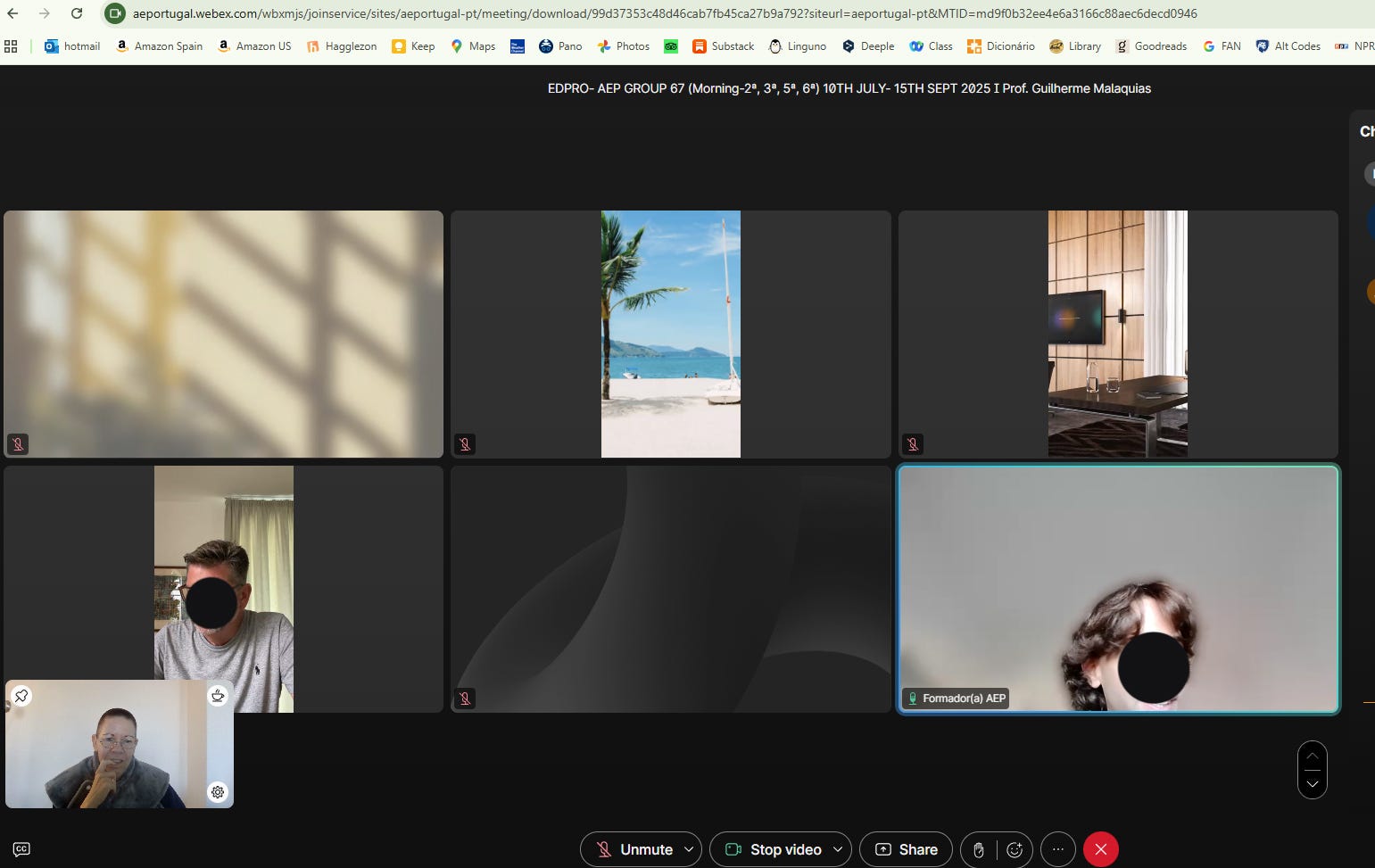
The other students were allergic to practicing. On class #7, only seven students did the homework. So what did we do? We did the homework in class. After that no one else did the homework. Frequently in class we had text to say. Waiting - sometimes minutes - for people to volunteer was painful. I felt terrible for the teacher. Until I asked him about it and he said, “What can I do? I can’t just call on them.” Um. You’re the teacher. You CAN call on them and end their free-loading and move the pace of the class along. The class provided me a great opportunity practice a much needed skill: Only caring about what I do, and not caring about what others do. Like the Mom who would volunteer, and then speak exactly what her 8 year old son - who was visible on camera - would tell her to say.
Brazilian vs European Portuguese
Brazilian Portuguese came up A LOT. A significant number of students had made the mistake of using Duolingo (which only has Brazilian Portuguese, not European).
In one of the first classes, we were learning to introduce ourselves, which included our occupation. Someone asked why accountant is contabalista instead of contador. The professor had never heard the word contador! It’s Brazilian and not used here.
Throughout the entire course, this issue arose over and over. This disparity between the two was not confined to words; grammar had significant differences as well. For example, the reflexive pronoun (He hurt himeself.) changes place in the sentence depending upon Brazilian or European Portguese!
No Test
Much to my dismay - remember, rule follower here - we had no test. For people who self-learn, they have to take the huge A1/A2 exam. People who go through the government course take tests throughout the course. We had not a single test. According to the company, it is up to the professor to decide if we will have tests.
I hope this all helps you figure out the method you’d like to use to learn Portuguese. One thing to keep in mind is your style of learning: are you a visual or auditory learner? Are you self-motivated? If you have any questions, just shoot me an email!
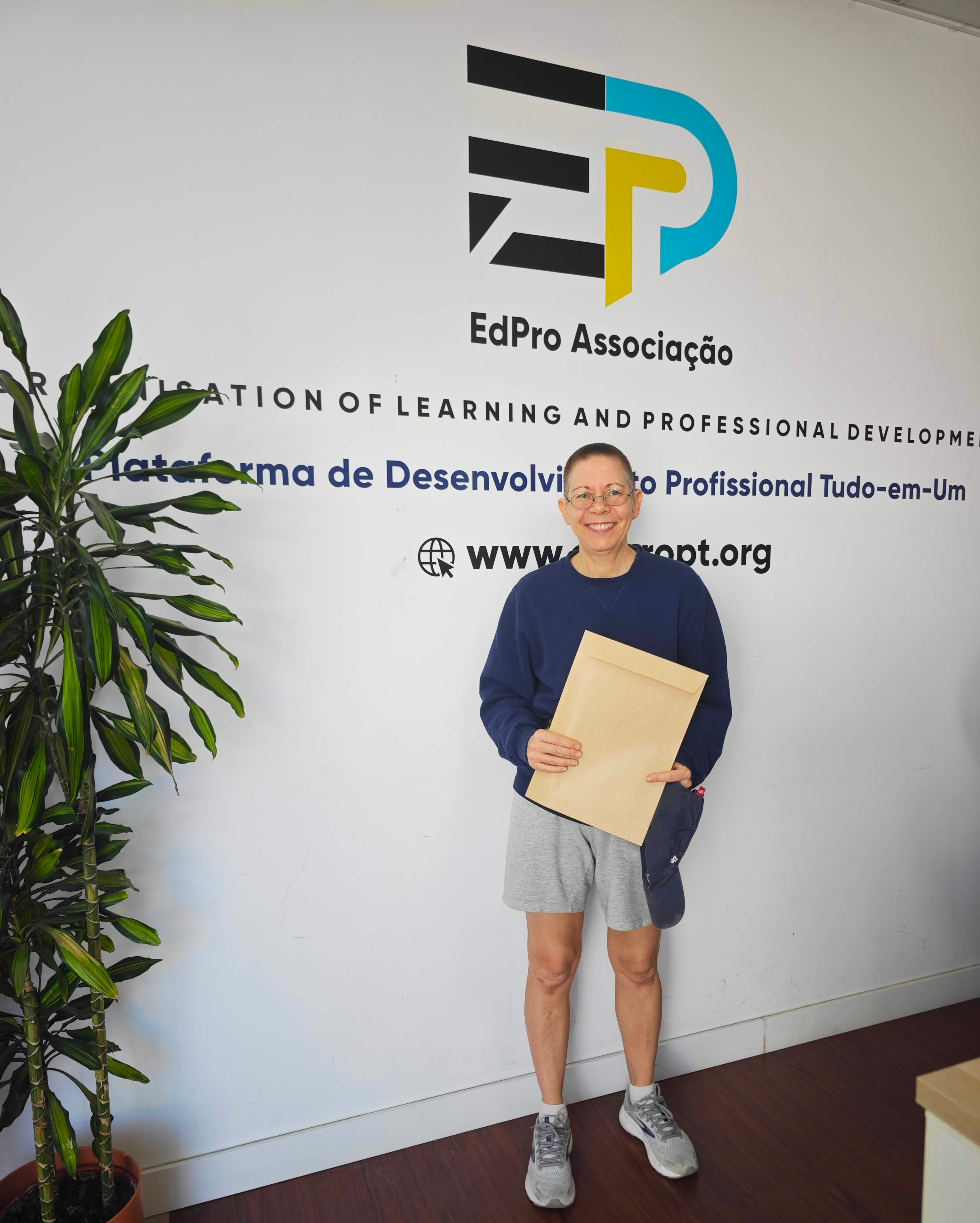
That’s all for now,
Love from Lisbon,
Amy
Today’s Weather
Partly sunny, high of 61f/16c, low of 44f/6c, low humidity, winds 15 mph/24 kph
All of Europe uses the Common European Framework of Reference for Languages.
CEFR Level Description (lifted from CEFR website)
A: Basic user
A1
Can understand and use familiar everyday expressions and very basic phrases aimed at the satisfaction of needs of a concrete type.
Can introduce themselves to others and can ask and answer questions about personal details such as where they live, people they know and things they have.
Can interact in a simple way provided the other person talks slowly and clearly and is prepared to help.
A2
Can understand sentences and frequently used expressions related to areas of most immediate relevance (e.g. very basic personal and family information, shopping, local geography, employment).
Can communicate in simple and routine tasks requiring a simple and direct exchange of information on familiar and routine matters.
Can describe in simple terms aspects of their background, immediate environment and matters in areas of immediate need.
B: Independent user
B1
Can understand the main points of clear standard input on familiar matters regularly encountered in work, school, leisure, etc.
Can deal with most situations likely to arise while travelling in an area where the language is spoken.
Can produce simple connected text on topics that are familiar or of personal interest.
Can describe experiences and events, dreams, hopes and ambitions and briefly give reasons and explanations for opinions and plans.
B2
Can understand the main ideas of complex text on both concrete and abstract topics, including technical discussions in their field of specialisation.
Can interact with a degree of fluency and spontaneity that makes regular interaction with native speakers quite possible without strain for either party.
Can produce clear, detailed text on a wide range of subjects and explain a viewpoint on a topical issue giving the advantages and disadvantages of various options.
C: Proficient user
C1
Can understand a wide range of demanding, longer clauses and recognise implicit meaning.
Can express ideas fluently and spontaneously without much obvious searching for expressions.
Can use language flexibly and effectively for social, academic and professional purposes.
Can produce clear, well-structured, detailed text on complex subjects, showing controlled use of organisational patterns, connectors and cohesive devices.
C2
Can understand with ease virtually everything heard or read.
Can summarise information from different spoken and written sources, reconstructing arguments and accounts in a coherent presentation.
Can express themselves spontaneously, very fluently and precisely, differentiating finer shades of meaning even in the most complex situations.
Yes, it is vital to learn the language for everyday use. But if you want to become a citizen or a permanent resident, you’ll need to have a certificate. Currently the requirement is A1/A2 level, but it may be changing to B1.
Allegedly you can get an exemption for hearing issues, but I could not get a response from anyone.
A requirement for the A1/A2 is 150 hours of classroom instruction.
Other places I looked were: PT Lab, NIALP Intercultural Association Lisboa, IEFP, and EDUSETPT.
Those four hours included a half hour break. We agreed to have a 15 minute class and get out 15 minutes early.
There was no book for the course.
To lock it in, I plan to write up those pages into a cheat sheet. I did one for the verb tenses and found it super helpful.
Congratulations on the tenacity you displayed in working to learn this difficult language—especially with your hearing loss. In the two years plus we’ve taken lessons, it’s been like the hare—slow and steady. Thank you for sharing.
Glad to hear you found a path that worked for you.
I am hearing impaired from birth with what is considered a moderate to severe loss. I wear hearing aids, and the technology has gotten steadily better over the years, but it is still adds an extra layer of difficulty to learning a foreign language. I suspect that people who develop a hearing loss later in life have.an even harder time than I do. I've spent my whole life having to fill in gaps from context to make up for what I couldn't hear so it's second nature. I had formal training in lipreading as a young teenager and I find that it does help me with Portuguese.
My spouse and I have been taking in person lessons for over four years now, mostly because we enjoy it and have a great relationship with our teacher. Our school is not qualified to give out the government certificates so we took the CIPLE (A2) about 2 years ago and the DIPLE (B2) in November. We passed both. The listening part was the hardest by far for me, as it is for everyone whether hearing impaired or not. If you are hearing impaired you can request special accommodations, which in practice means you get to go to a separate room and use headphones, as opposed to being in the main test room and hearing on speakers, which are not very good quality. You do need to get a doctor's letter but that's not too difficult. I did not bother getting an accommodation for the A2 but did for the B2. Unfortunately I made the mistake of starting out using the headphones with my hearing aids out but the volume was not sufficient. I was able to put my hearing aids back in and use the headphones over them which worked better, but there is no way to pause the test so I got distracted and didn't do very well on the section. Fortunately I did better on the others.
If you are hearing impaired, I would recommend avoiding having to take the CIPLE, but if you can't find another alternative, it is possible to pass it. Defininitely request the accommodation though!